Hello!
from Jerel Johnson
Introduction
At the Rhode Island School of Design I have taken it upon myself to experiment with existing digital platforms and to explore a variety of graphic and interaction models within my practice. I have questioned both what is beautiful, functional, and exciting—especially in the context of our algorithmic age. My aim in doing so at RISD is to learn through a deliberate process of making and breaking that leads to innovative approaches within the professional practice of user experience and graphic design.
Some of the projects here are raw and still in progress, but demonstrate the areas I've been working in.
Tax Havens & Networks on the Map
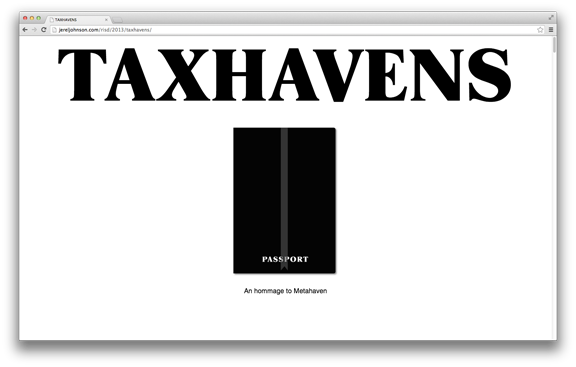
Tax Havens and Networks on the Map project is a work in progress that will ultimately present ten instances of speculative bank assets, maps, and a "tracert" tour through the Google Earth API.
A tax haven must be a public secret. They must be visible and yet offer invisibility. As Sean Hastings (2010), in an interview with Metahaven, has pointed out: “a tax haven — or any other haven for that matter must be publically available to be useful.” My tax havens project explores the logic of the tax haven as an island node on economic and information networks. Tax havens offer a mechanism of obfuscation. Their logic operates through camouflage, stand-ins, layers, and the shell game.
ANTI–FACE
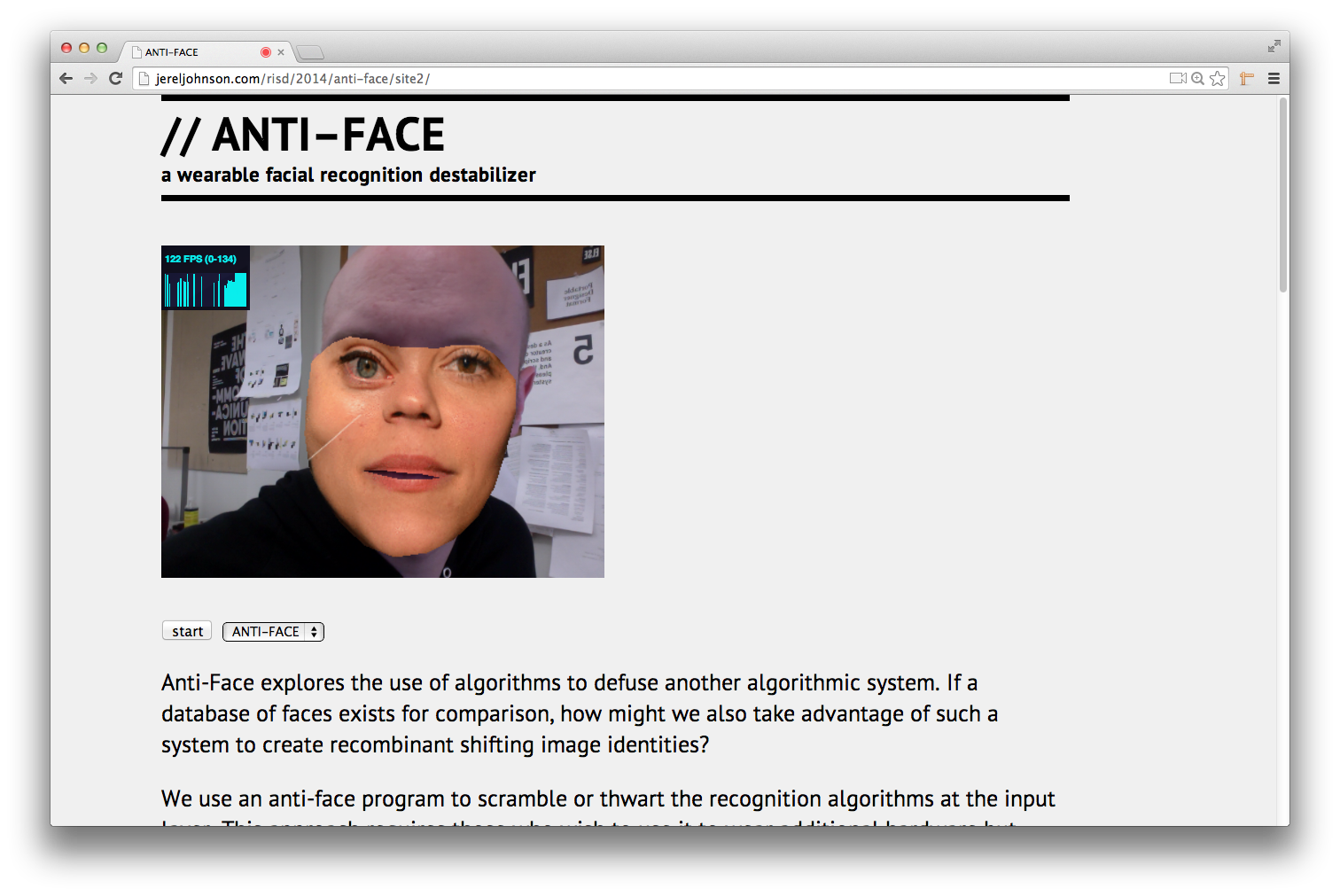
ANTI-FACE is a speculative design response to the increasing use of facial recognition algorithms in our culture. The speculative product is a wearable facial recognition destablizer. Anti-Face explores the use of algorithms to defuse another algorithmic system. If a database of faces exists for comparison, how might we also take advantage of such a system to create recombinant shifting image identities?
We use an anti-face program to scramble or thwart the recognition algorithms at the input layer. This approach requires those who wish to use it to wear additional hardware but, finally, that hardware has become extremely lightweight.
The terrain of facial recognition is one where a politics of algorithms is most apparent—biometric algorithms embody normative conceptions of identity particularly as they are expressed in physical features.
This project was completed over a weekend workshop. It needs more polish.
Visit ANTI-FACE
Revolution Teleporter
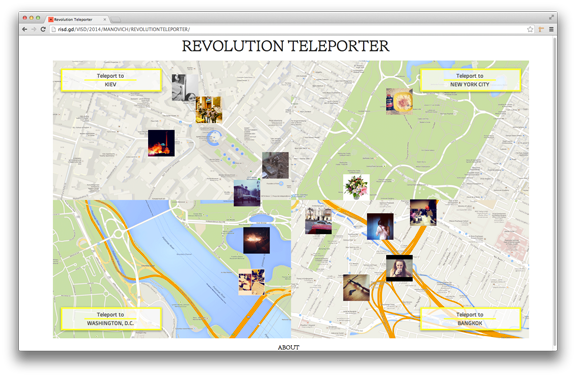
The revolution teleporter project developed in collaboration with Ojus Doshi, MFA 2015, Jonathan Hanahan, MFA 2014, and Prin Limphongpand, MFA 2015, remaps images of the Kiev protests sourced from Instagram into other locations. This project draws its power from the ability to calculate geo-coordinates in order transpose images from a revolution into a new location. This algorithmic operation helps us further understand and relate to images from afar. By force of algorithm, we can visit these images upon other cities (New York, Washington D.C., and Bangkok). Each iconic monument serves as a pin on the map with images from the Kiev protests loaded around it. The revolution takes place in familiar spaces where scale and point of view are explored — and new relationships to current events are generated algorithmically.
This project was done over a weekend workshop. It needs performance optimization.
Visit Revolution Teleporter
Walk in L.A. via Google Earth
A walk in downtown L.A. via Google Earth exploits the aerial efficiencies of their texture mapping algorithms by bringing the camera as close to the ground as possible, tilting it parallel to the horizon, and then proceeding to move through space. In other words, by treating Google Earth as if it were Google Street view we an entirely different experience of the system is revealed.
The soundtrack is a remix of Howard Shore’s “The Exhibition” from the Scanner’s Soundtrack, my own “If something is boring after two minutes, try it for four...” and “Angel Echoes” by Four Tet off of the wonderful “There is love in you.”
Five Theses for a Thesis
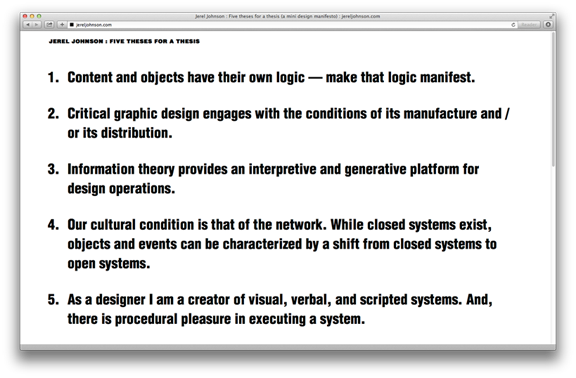
Five Theses for a Thesis is an ongoing effort that engages with multiple platforms by delivering the “same” content, my five theses, in a variety of ways. Each instance seeks to be attuned to the differences in the platform or distribution channel. For instance, the Five Theses posted on Imgur take the form of the Advice animals meme, posted to Spotify the first word in the title of each track forms the each thesis sentence, Pirate Pad is a fully editable text that anyone can alter, anyone with a link to the Google doc can comment, the thesis have been broken up into independent tweets on Twitter, etc. The form and content adjust themselves to fit the space of the distribution channel, and from a comparative standpoint comment upon it.
Visit Five Theses for a Thesis
Grotesque Platform
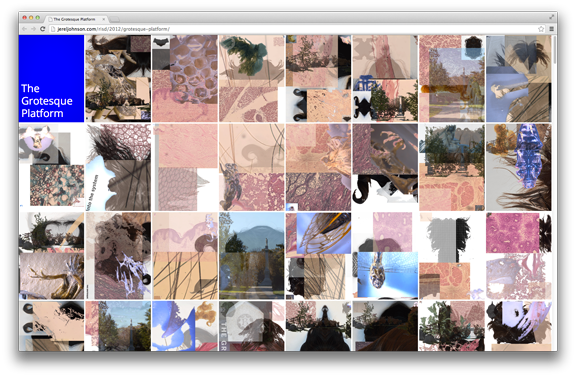
The Grotesque Platform explores the migration of the concept of the grotesque through time. The migration traverses three levels: subject matter, page composition, and disequilibrium in the system.
The Grotesque Platform consists of a database and an algorithm that together create multiple 18 x 24 inch posters. The database establishes the grotesque at the subject matter level. It is an archive of text, pictures of human hair,photos of the Swan Creek cemetery, as well as insect parts, skin, bone and other biological material that I scanned at RISD’s Nature Lab. The algorithm, on the other hand, establishes the grotesque at the composition and system levels. The algorithm is written in JavaScript for use with Photoshop. It randomly selects and executes a limited set of design transformations: scale, transparency, layering, rotation, reflection and position. These transformations are subject to further but constrained variation through the script.
The initial use of the Grotesque Platform resulted in 300 posters and a website which presents two different browsing interfaces for them (this collection shows a final third interface). For me, the Grotesque platform was a successful first step in developing a scripted system that carves out its own space of possibility through algorithmic means while binding formal and conceptual reasoning.
Visit Grotesque Platform